hooray CTs over.
I need A for physics and chem, B for all the rest. And darn, that is really hard to get, considering that are the CTs are not easy.
Problematic subjects: Econs and KI. I think that the critical thinking could probably save my essay for me to get a B, but econs! 12 marks out of 50 marks are gone because didn't do the questions... sigh. And being an essay writing humanities subject, there is no guarantee to how many more marks I can lose. I can only afford to lose 8 more marks. oh man. oh woman. oh hermaphrodite. oh eunuch.
Wish I could transfer a few marks from my other subjects to save econs. If I could, I'll transfer 4 marks each from physics and math. (But of course they should not implement that because China scholars can just pass econs, pass GP, then from math physics chem transfer here tranfer there get all A. China scholars, it's all your fault.)
Speaking of transfering marks, this reminds me of the Kyoto Protocol as mentioned in my econs paper, where companies that exceed their carbon emmisions quota could buy "carbon credits" from those green companies that are more efficient than required by Kyoto Protocol, or else they face a fine that is much higher than the price of carbon credits. Singapore joined Kyoto protocol not because we want to save the earth, but because the government wants Singapore companies to earn carbon credits to sell overseas.
Man what a business opportunity because of certain requirements expected.
Just like tuition.
Friday, June 30, 2006


Tuesday, June 27, 2006
I can't believe my luck!
I broke my spectacles the night before chem CT, at like 2 am. Good thing I have a spare that is 100 degrees less. Makes me giddy though.
Anyway, to ensure I wake up on time for the test, I set 2 alarm clocks to 5.50am. They never failed to wake me up before. I made sure they were activated before I went to sleep.
The next morning the first thing I realised was that it was 7.45 am! w00t! I'm supposed to be in school at like... NOW??!! So I just wore my uniform, splashed some water at my face, drank milo and went off. (good thing my father helped me call a cab) Took a cab. Rush hour. 30 minutes ride. Reached the LT at 8.25am. The paper started at 8.11am. w00tness... I have like 15 mins less than everyone else to do the paper.
But then again look at the bright side, I have 15 mins more to study/sleep! By taking taxi I saved 10 minutes! So in total I have 25 more minutes to invest in chem test(by studying or sleeping)!
Buahahaha I bet you are all jealous.
I broke my spectacles the night before chem CT, at like 2 am. Good thing I have a spare that is 100 degrees less. Makes me giddy though.
Anyway, to ensure I wake up on time for the test, I set 2 alarm clocks to 5.50am. They never failed to wake me up before. I made sure they were activated before I went to sleep.
The next morning the first thing I realised was that it was 7.45 am! w00t! I'm supposed to be in school at like... NOW??!! So I just wore my uniform, splashed some water at my face, drank milo and went off. (good thing my father helped me call a cab) Took a cab. Rush hour. 30 minutes ride. Reached the LT at 8.25am. The paper started at 8.11am. w00tness... I have like 15 mins less than everyone else to do the paper.
But then again look at the bright side, I have 15 mins more to study/sleep! By taking taxi I saved 10 minutes! So in total I have 25 more minutes to invest in chem test(by studying or sleeping)!
Buahahaha I bet you are all jealous.
Sunday, June 25, 2006
I still remember part of the speech during the Council's investiture. The part from Alice in Wonderland.
If you don't remember, fear not! I have the book and I shall quote it directly.
***
'Cheshire Puss,' she began, rather timidly, as she did not at all know whether it would like the name: however, it only grinning a little wider. 'Come, it's pleased so far,' thought Alice, and she went on. 'Would you tell me, please, which way I ought to go from here?'
'That depends a great deal on where you want to get to.' said the Cat.
'I don't care much where - ' said Alice.
'Then it doesn't matter which way you go,' said the Cat.
' - so long as I get somewhere,' Alice added as an explanation.
'Oh, you're sure to do that,' said the Cat, 'if you only walk long enough.'
***
It does seem that one needs a goal to know what to do. Perhaps, when you ask yourself, "What should I do now?" It really depends on what you want to achieve. And if you believe in a mechanistic universe, "want" doesn't really make sense. How can this blob of interacting charged particles "want" something? Yet it seems like it does. Strange.
What if I take it that if a system tends towards a certain condition, I say that it "wants" that condition? So if a person tends to a state of happiness, then he wants to be happy? If an atom tends to form an octet configuration, it "wants" to form an octet configuration? If unlike poles attract each other, they "want" to be together?
Hmm wait, don't they all obey the second law of thermodynamics?
So, if we all tend towards where we want to get to, why do I still get lost, and wonder what everything is for? Why am I searching for what I really want, even though it is just supposed I want to do now?
Perhaps it's because what I want to do now may make it difficult for me to do something else later.
If you don't remember, fear not! I have the book and I shall quote it directly.
***
'Cheshire Puss,' she began, rather timidly, as she did not at all know whether it would like the name: however, it only grinning a little wider. 'Come, it's pleased so far,' thought Alice, and she went on. 'Would you tell me, please, which way I ought to go from here?'
'That depends a great deal on where you want to get to.' said the Cat.
'I don't care much where - ' said Alice.
'Then it doesn't matter which way you go,' said the Cat.
' - so long as I get somewhere,' Alice added as an explanation.
'Oh, you're sure to do that,' said the Cat, 'if you only walk long enough.'
***
It does seem that one needs a goal to know what to do. Perhaps, when you ask yourself, "What should I do now?" It really depends on what you want to achieve. And if you believe in a mechanistic universe, "want" doesn't really make sense. How can this blob of interacting charged particles "want" something? Yet it seems like it does. Strange.
What if I take it that if a system tends towards a certain condition, I say that it "wants" that condition? So if a person tends to a state of happiness, then he wants to be happy? If an atom tends to form an octet configuration, it "wants" to form an octet configuration? If unlike poles attract each other, they "want" to be together?
Hmm wait, don't they all obey the second law of thermodynamics?
So, if we all tend towards where we want to get to, why do I still get lost, and wonder what everything is for? Why am I searching for what I really want, even though it is just supposed I want to do now?
Perhaps it's because what I want to do now may make it difficult for me to do something else later.
Monday, June 19, 2006
Random thought:
Ever read any stories where the protagonist is sucked into the mirror? Maybe you haven't, or maybe you have watched a channel 8 tv show "My date with a vampire II" (sometime in 2000). In those cicumstances, the protagonist who gets sucked into the mirror finds out that all the words are laterally inverted, and that right handed people are now the minority! Oh my! Just imagine yourself being sucked into a mirror! But as I thought about it, those would probably be two of the last few things I'll worry about.
Being in a world where everything a a mirror image of your current world also means that all your laevorotatory optically active compounds would become dextrorotatory compunds. This has more serious implications that having to read everything through a mirror. Recall that many biological molecules are optically active.
Firstly, you can't eat anything there except for saturated fats, glycine, salt and tartaric acid. All other foods are non-superimposable with the kind that your body can use. You can't take any vitamins, suppliments or medicine, as they all have to be dealt with by emzymes. Ahh, you wouldn't suffocate though, majority of gas molecules in the air are achiral.
Secondly, you would be immune to all diseases that come from the exterior. The microbes that try to make you sick wouldn't be able to penetrate your defenses to do anything serious, because the macrophages would engulf everything that the body doesn't recognise, and even if they get through they have nothing to eat. Ahh, true, virii don't need to eat, but they can't do anything to your cell either because they can't even force their way into the cell. They can't take control either because all their proteins or RNA enzymes are optically active.
Thirdly, most things would smell and taste different. Our smell receptors idenitify the molecule's shape. So probably what smells nice here wouldn't smell quite as nice there. As for taste, sour and salty tastes would remain the same because they depend on ions, which are achiral.
Lastly, male or female, whoever goes there would be sterile. The enzyme that the sperm uses to penetrate the ovum would not work there. (If you recall, you are effectively immune to all pathogen caused diseases too) Perhaps this means that you would not need contraception in the mirror world.
Pretty cool huh?
Ever read any stories where the protagonist is sucked into the mirror? Maybe you haven't, or maybe you have watched a channel 8 tv show "My date with a vampire II" (sometime in 2000). In those cicumstances, the protagonist who gets sucked into the mirror finds out that all the words are laterally inverted, and that right handed people are now the minority! Oh my! Just imagine yourself being sucked into a mirror! But as I thought about it, those would probably be two of the last few things I'll worry about.
Being in a world where everything a a mirror image of your current world also means that all your laevorotatory optically active compounds would become dextrorotatory compunds. This has more serious implications that having to read everything through a mirror. Recall that many biological molecules are optically active.
Firstly, you can't eat anything there except for saturated fats, glycine, salt and tartaric acid. All other foods are non-superimposable with the kind that your body can use. You can't take any vitamins, suppliments or medicine, as they all have to be dealt with by emzymes. Ahh, you wouldn't suffocate though, majority of gas molecules in the air are achiral.
Secondly, you would be immune to all diseases that come from the exterior. The microbes that try to make you sick wouldn't be able to penetrate your defenses to do anything serious, because the macrophages would engulf everything that the body doesn't recognise, and even if they get through they have nothing to eat. Ahh, true, virii don't need to eat, but they can't do anything to your cell either because they can't even force their way into the cell. They can't take control either because all their proteins or RNA enzymes are optically active.
Thirdly, most things would smell and taste different. Our smell receptors idenitify the molecule's shape. So probably what smells nice here wouldn't smell quite as nice there. As for taste, sour and salty tastes would remain the same because they depend on ions, which are achiral.
Lastly, male or female, whoever goes there would be sterile. The enzyme that the sperm uses to penetrate the ovum would not work there. (If you recall, you are effectively immune to all pathogen caused diseases too) Perhaps this means that you would not need contraception in the mirror world.
Pretty cool huh?
Sunday, June 18, 2006
I remember that a friend introduced me to the "hedgehog's dilemma". Supposedly, if two people are too far apart they would be sad because they are lonely, but if they are too close they can hurt each other too. So he said that his solution would be to stay far away.
I suppose that he might be right if the hurt you can get from being too close would never be greater than the worst loneliness you can possibly get. However, if that is the case, then people would not come together to form societies; they would be more like plants, the farther apart, the better. So apparently there seems to be an optimal distance.
But where is it? I thought of this:

Apparently, you would get a graph like this when you plot

where k and p are positive constants, a > b > 0.
If you are that interested in the ideal distance, you can differentiate and work out the solution, but it would be pointless because we don't know what y, k, x, a, p, b stand for.
BUT the repulsive force probably doesn't go up forever! E.g, When two hydrogen atoms get too close, they experience Coulomb repulsion, but if they get really really close, they can attracted to each other due to residual strong force. (which is stronger than Coulomb repulsion at that distance, then the weak force would turn one of the protons into a neutron so there's no more Coulomb replusion) Then they will stay together, and nothing but a blackhole can tear them apart!
Well... I leave that to your interpretation. My point is, staying far away probably isn't the best policy.
I suppose that he might be right if the hurt you can get from being too close would never be greater than the worst loneliness you can possibly get. However, if that is the case, then people would not come together to form societies; they would be more like plants, the farther apart, the better. So apparently there seems to be an optimal distance.
But where is it? I thought of this:
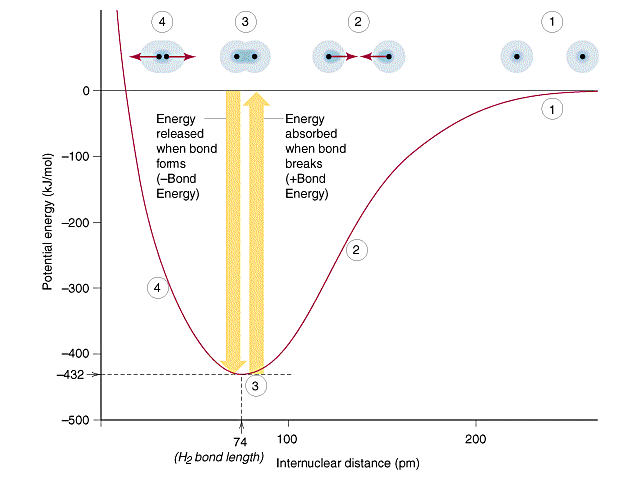
Apparently, you would get a graph like this when you plot


where k and p are positive constants, a > b > 0.
If you are that interested in the ideal distance, you can differentiate and work out the solution, but it would be pointless because we don't know what y, k, x, a, p, b stand for.
BUT the repulsive force probably doesn't go up forever! E.g, When two hydrogen atoms get too close, they experience Coulomb repulsion, but if they get really really close, they can attracted to each other due to residual strong force. (which is stronger than Coulomb repulsion at that distance, then the weak force would turn one of the protons into a neutron so there's no more Coulomb replusion) Then they will stay together, and nothing but a blackhole can tear them apart!
Well... I leave that to your interpretation. My point is, staying far away probably isn't the best policy.
Thursday, June 15, 2006
How do you be an optimist?
Think opportunity cost!
"Man, I broke my toy dog. But that's ok, I'll end up spending less time and battery on it and have more space for my toy kitten!"
How do you be a pessimist?
Think opportunity cost again!
"Ok it's the school holidays, but that means I'll have less time with my friends, less time in the nice library, likely to get bored, more likely to overspend etc. Oh bother."
So what separates the two? Well, the pessimist thinks more about what he loses, while the optimist thinks more about what he gains. Not so much of glass half full or half empty.
Think opportunity cost!
"Man, I broke my toy dog. But that's ok, I'll end up spending less time and battery on it and have more space for my toy kitten!"
How do you be a pessimist?
Think opportunity cost again!
"Ok it's the school holidays, but that means I'll have less time with my friends, less time in the nice library, likely to get bored, more likely to overspend etc. Oh bother."
So what separates the two? Well, the pessimist thinks more about what he loses, while the optimist thinks more about what he gains. Not so much of glass half full or half empty.
A: "Are you kidding?"
B: "Why should I lie to you?"
B imples that he is not lying. Let's see how that is implied. Let's say A answers the rhoetorical question.
"Hmm I can't think of a reason why you should lie to me."
So let's see.
P1: If I lie to you, I have a reason to lie to you.
P2: I do not have a reason to lie to you.
C: Therefore I am not lying to you.
Hmm... although the reasoning is correct, the first premise seems weird. Let's try another.
P1: If I have a reason to lie to you, I would lie to you.
P2: I do not have a reason to lie to you.
C: Therefore I am not lying to you.
Now the premise makes more sense, but the argument is invalid.
The reasoning for "How would I know?" and "What to do?" is quite similar. They are likely invalid too.
B: "Why should I lie to you?"
B imples that he is not lying. Let's see how that is implied. Let's say A answers the rhoetorical question.
"Hmm I can't think of a reason why you should lie to me."
So let's see.
P1: If I lie to you, I have a reason to lie to you.
P2: I do not have a reason to lie to you.
C: Therefore I am not lying to you.
Hmm... although the reasoning is correct, the first premise seems weird. Let's try another.
P1: If I have a reason to lie to you, I would lie to you.
P2: I do not have a reason to lie to you.
C: Therefore I am not lying to you.
Now the premise makes more sense, but the argument is invalid.
The reasoning for "How would I know?" and "What to do?" is quite similar. They are likely invalid too.
Subscribe to:
Posts (Atom)